
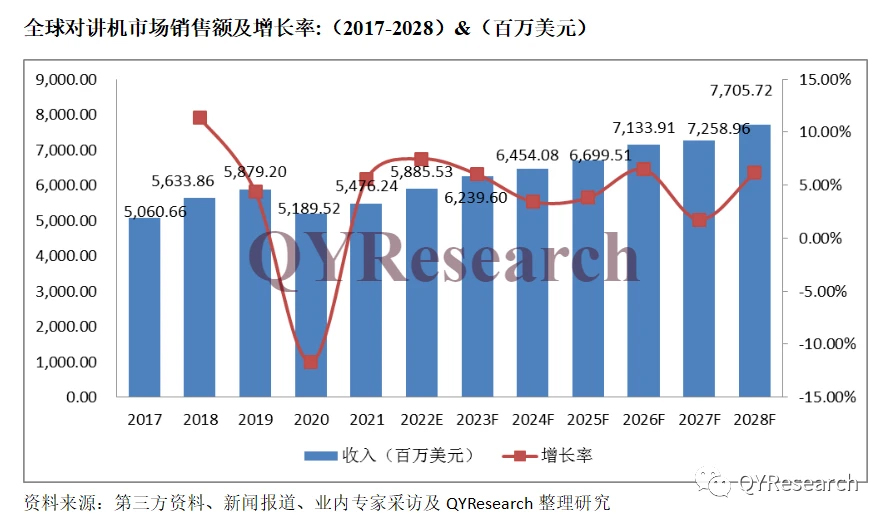
Walkie-talkie Industry Research-The global market size is expected to reach 7.706 billion US dollars in 2028
2023-03-29

The walkie-talkie is a two-way mobile communication tool. It can make calls without any network support, and there is no call charge. It is suitable for relatively fixed and frequent calls. There are two types of walkie-talkies: digital walkie-talkies and analog walkie-talkies. The downstream segment market can be divided into three categories: government and public security (public security, fire protection, armed police, justice, emergency, etc.), public utilities (rail transit, energy, water conservancy, etc.), industry and commerce (property security, service industry, construction wait).
Analysis of the current status of the walkie-talkie industry.
Analysis of the current status of the walkie-talkie industry.
The walkie-talkie industry is highly competitive
One is Motorola, a global leader in the professional wireless communications industry. Motorola has profound technology accumulation, strong comprehensive strength, and obvious advantages in core patents and core technologies. It has dominated the formulation of major global professional wireless communication technology standards, occupied the high-end market of the industry, and occupied the global professional wireless communication industry. most of the market share. The second is the main challengers in the professional wireless communication industry such as Kenwood, Hytera, and ACM. These manufacturers have their own core technologies, they compete with industry leaders in certain market segments, and have achieved good market performance. The third is other companies in the industry. Compared with the above two types of enterprises, these enterprises are smaller in scale, weaker in technology research and development, and are in the role of followers. They usually do not have their own core technology, and generally adopt low-price marketing and low-cost competition strategies to gain market share. Most of the market is concentrated in low-end customers in the industrial and commercial fields with high local price sensitivity and a large number, occupying a certain market share.
With the establishment of the global broadband trend, the needs of users in various industries are gradually changing, and the demand for broadband is gradually emerging. The traditional private network manufacturers only invest in narrowband communication, which has shown great limitations, and some enterprises have encountered bottlenecks in their development. In order to achieve complementary advantages and strong alliances, cooperation, mergers and acquisitions in the industry occur frequently.
The development trend of walkie-talkie
Looking at the world, the walkie-talkie market has begun to stabilize and recover in the post-epidemic era. According to a survey report by QYResearch, global walkie-talkie shipments will rebound in 2021 after experiencing a decline in 2020 due to the epidemic. It is expected to maintain a compound growth rate of 4.27% from 2022 to 2028. At the same time, new broadband technologies and narrowband technologies are co-existing and co-developing together, forming an industrial development trend of public-private integration. Broadband technologies such as PoC and MCS have gradually gained industry consensus as the next-generation key communication evolution direction of private network communications. In the next five years, the number of users will maintain rapid growth at an annual growth rate of 17%, and will be integrated into the industry's digital solutions to help the industry develop sustainably.
With the evolution and development of the new generation of information technology, the concept of dedicated communication has gradually broken through the original industry structure and has become an important part of the global digital economy. Large-scale cross-border integration has become the new normal, and more new application scenarios As a result, the vertical industry will form a landing application and give birth to a series of innovative business models, the industry ecology will become more prosperous, and the opportunities and challenges faced by walkie-talkie companies will coexist.
Overall Scale Analysis of Global Walkie-Talkie
In 2021, the global walkie-talkie market will reach US$5.476 billion, and it is expected to reach US$7.706 billion in 2028, with a compound annual growth rate (CAGR) of 4.59%. From the perspective of production, China, North America and Southeast Asia are important production regions, and they will occupy 42.08%, 20.13% and 23.78% of the market share respectively in 2021. Will reach 42.91%. In terms of consumption, North America is currently the largest consumer market in the world, accounting for 31.42% of the market in 2021, followed by Europe and China, accounting for 26.24% and 10.51% respectively. It is expected that in the next few years, China will grow the fastest, with a CAGR of about 5.82% during 2022-2028.
From the perspective of product type and technology, digital walkie-talkies account for the largest proportion, accounting for 52.47% of the global market share in 2021. With the popularization of the application of private network communication equipment, the problem of insufficient frequency resources will become more prominent. At the same time, the needs of users will continue to increase, and the use environment will become more and more complex. Mid-to-high-end customers in the industry will be more inclined to use digital products. However, due to the maturity of analog product technology, competitive price, and large market stock, it is still obviously attractive to domestic industrial and commercial users and public utility users. Although "analog to digital" is the trend of the times, it is still a gradual process. From the perspective of different usage methods, the sales share of portable walkie-talkies has a rapid growth rate, and will account for 88.01% of the global market share in 2028. Mobile is more suitable for specific industries, such as government and public safety.
From the perspective of application fields, the downstream industries of the walkie-talkie industry are mainly government and public security, public utilities, and industrial and commercial industries. The demand changes and industrial policies of these downstream markets directly affect the operating efficiency and sustainable development of the industry. The government and public safety field in the downstream industry is a key industry to ensure national security, and the global sales volume will account for 41.39% in 2021. The field of public utilities and rail transit is a functional industry that ensures the normal operation of social life. In 2021, the global sales volume will account for 27.48%. The industrial and commercial market is an important pillar of the national economy. Professional wireless communication products play an important role in ensuring that these industries can effectively perform their functions. In 2021, global sales accounted for 25.11%. In short, the walkie-talkie industry will gain wider applications and broader market prospects with the development of its downstream industries, creating good development opportunities for walkie-talkie companies.
JVCKENWOOD presents VP8000 digital two-way portable walkie-talkie at IWCE 2023
In the 5G era, Hytera's latest terminal opens a new experience of public network intercom
Related Article

A practical guide to testing two-way radio coverage in the environment where people will actually depend on it.
Why a Radio Coverage Test Can Pass— and the System Still Fails in Real Operation

Most radio operators never take grounding seriously—until their gear is fried. This piece exposes three fatal grounding traps, from shallow rods to mixed signal-and-power grounds, then hands you a six-step, code-compliant checklist drawn from NEC Article 810 and IEEE Std 142. Copy this homework instead.
A grounding error can instantly fry your radio—Installation guide for radio system lightning protection

Professional walkie talkie earpiece guide covering how to put on, wear, and use earpieces correctly. Features brand-specific tips for Motorola, Hytera, Baofeng, and more with structural comparisons for optimal comfort and performance.
How to use walkie talkie earpiece?- The Complete Guide to Walkie Talkie Earpiece Setup
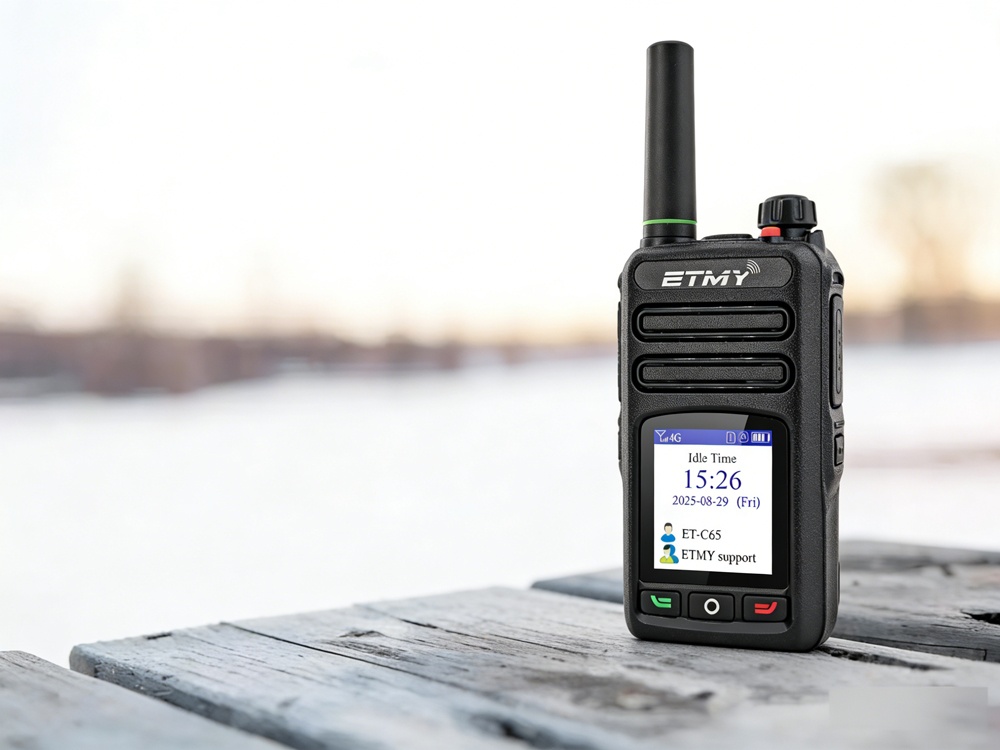
A recent industry report highlights PoC radio adoption for faster, long-distance team communication. Designed for cellular network connectivity, these radios improve coordination in public safety, logistics, and field operations, while offering beginner-friendly setup guidance to ensure reliable activation and compliance.
How exactly do you use a newly acquired PoC radio?