
Learn how long-range two-way radio communications work
author: ETMY RF Technical Team
2025-07-11

Radio waves do not care about roads, oceans, or mountains; they simply obey Maxwell’s equations. Yet the same 5 W handheld radio that reaches 30 km across open water may drop off after 500 m inside a reinforced concrete structure. Bridging that physical gap is both the art and the engineering science of two-way radio communication.
The Electromagnetic Path: VHF vs. UHF Propagation
Radio propagation depends directly on operating wavelength and terrain geometry:
VHF (136–174 MHz): With wavelengths of roughly two meters, diffraction allows signals to bend over rolling hills and pass through rural tree canopies, giving field operators dependable coverage across open countryside.
UHF (400–470 MHz): Shorter 70cm waves penetrate window glass, masonry, and steel rebar much more effectively, making UHF the standard choice for indoor and urban operations despite roughly 8 dB higher free-space path loss.
Above 700 MHz: While structural penetration improves further, dense foliage and human body absorption add 15–20 dB/km of signal attenuation, making direct handheld-to-handheld line-of-sight critical.
Analog and digital bricks in the wall
Traditional FM modulation is simple and proven, but standard 12.5 kHz analog voice occupies valuable spectrum and accumulates static as signal strength diminishes. Digital Mobile Radio (DMR) digitizes voice at 2.4 kbps with advanced AMBE+2™ vocoders and uses 2-slot TDMA (Time Division Multiple Access) to fit two independent conversations into the same 12.5 kHz channel. This doubles spectral efficiency and eliminates background hiss without increasing RF interference. Similarly, P25 Phase II serves North American public safety networks, while NXDN utilizes 6.25 kHz FDMA channelization for narrowband efficiency.
Repeaters: the altitude multiplier
The Friis transmission equation demonstrates the decisive role of antenna elevation: doubling antenna height provides a significant gain in effective optical horizon. A repeater installed atop a building rooftop or mountain ridge turns a 5 W portable into a high-coverage system. Properly engineered base stations utilize precision duplexer cavities tuned to isolate transmitter and receiver frequencies (typically 600 kHz split for VHF or 5 MHz for UHF) with insertion loss under 0.5 dB. By adding CTCSS/DCS sub-audible access tones and linking multi-site repeaters over IP networks, communication networks can seamlessly span entire industrial campuses and regional facilities.
Spectrum Licensing and Operating Regulations
Operating high-power RF gear requires strict adherence to international and local telecommunication frameworks:
Licence-Free Allocations: Frequencies like 409 MHz (public band, 0.5W), PMR446 (Europe), and FRS (North America) offer pre-programmed channels without licensing fees—ideal for recreational outdoors and light hospitality, but limited for mission-critical logistics.
Commercial & Marine Allocations: Dedicated commercial UHF/VHF frequencies require coordinated licensing. In contrast,aviation (118–137 MHz AM) and maritime (156–163 MHz) follow strict international channel assignments. Unauthorized transmission risks heavy regulatory penalties and creates harmful interference on emergency channels.

Equipment families
• Handheld radio: 1–5 W output, SMA/BNC whip antennas; optimized for ergonomic weight, audio volume, and battery shift life (12–18 hours).
• Mobile vehicle radio: 10–50 W output, permanent NMO or magnetic roof mount antennas; active heatsink cooling fans required for high-duty transmissions.
• Base Stations & Repeaters: 5–100 W 100% continuous duty cycle, heavy-duty cavity filters, and battery backup systems.
• Intrinsically safe (explosion-proof) radios are designed to limit the risk of ignition from radio-frequency (RF) energy or electrical sparks. They typically operate at low power—generally under 3.5W—to prevent the generation of sparks in environments such as petrochemical plants.
A coordinated field emergency team might deploy 0.5W licence-free radios for short-range team coordination, place a 50 W VHF vehicle unit at a high-elevation pass to link surrounding valleys, and bridge signals through an IP-linked DMR Tier II gateway back to dispatch headquarters. Minimizing coaxial cable losses (keeping attenuation <2 dB per 100 m with low-loss 50-ohm feeder cables) and utilizing high-gain directional antennas provide 3–6 dB of system gain—effectively doubling coverage without exceeding transmitter legal limits.
Manufacturing and Quality Engineering
At ETMY, commercial two-way radios and repeaters are engineered from component-level SMT assembly through automated optical inspection (AOI). Our in-house RF testing facilities validate frequency stability, harmonic suppression, and receiver sensitivity (≤0.2 µV) across industrial temperature ranges (-20°C to +60°C). Combined with rigorous drop tests and IP-rated environmental sealing, our radio equipment is built to deliver dependable connectivity in demanding commercial and professional environments worldwide.
What is FCC ID? What does it mean when a walkie-talkie has FCC ID?
What is a CB radio? Is it still used?
Related Article
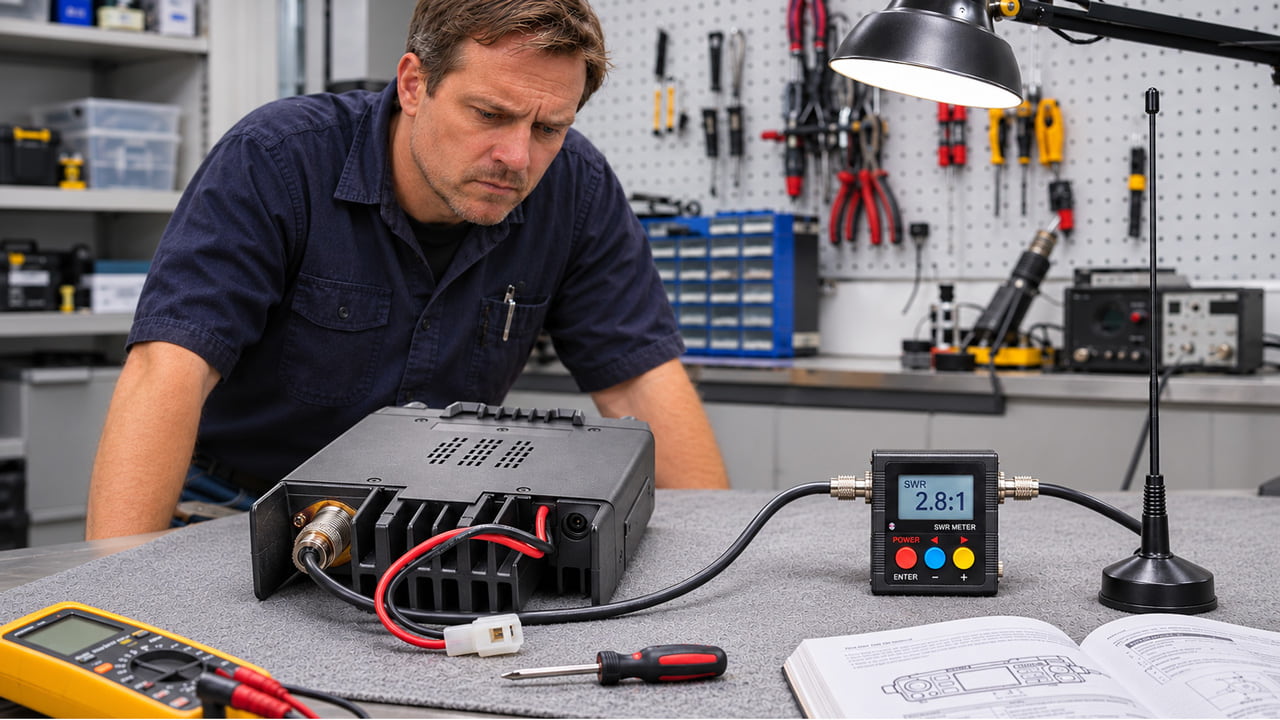
A 5W mobile paired with a 50W antenna is not 45W of headroom. EIRP sets the legal ceiling, VSWR over 2.0:1 turns reflected power into connector heat, and PA derate is a warning, not a fix. Budget 30–50% of nameplate, run a +200 °C PTFE RG-316 feedline, and treat a 100W-class whip like the ETMY AZ510FX as a ceiling, not an invitation to climb.
5W Radio With a 50W Antenna: UHF Antenna Power Rating and the 3 Red Lines That Kill Mobile Radios

When a 5W walkie talkie cannot reach a repeater in the mountains, the fault is rarely the transmitter. Radio-horizon math shows a waist-high antenna sees only about five kilometers, while a single mid-size hillside quietly absorbs 10 to 30 dB of signal. Adding power buys only marginal gain; climbing fifteen meters to a ridge line often unlocks what twenty watts never could. Antenna height remains the first variable; terrain, not radio, sets the ceiling.
Why Your 5W Handheld Radio Can't Hit the Mountain Repeater?

A practical guide to testing two-way radio coverage in the environment where people will actually depend on it.
Why a Radio Coverage Test Can Pass— and the System Still Fails in Real Operation
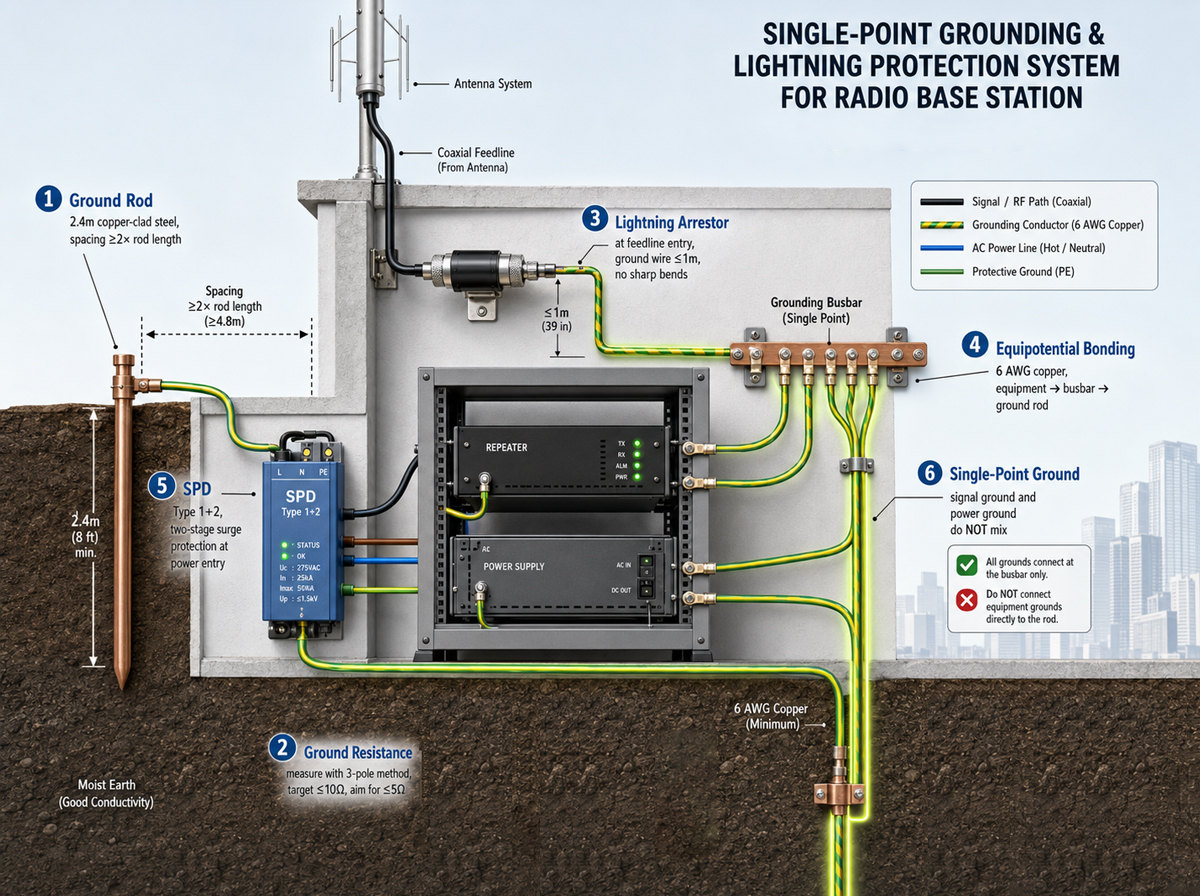
Most radio operators never take grounding seriously—until their gear is fried. This piece exposes three fatal grounding traps, from shallow rods to mixed signal-and-power grounds, then hands you a six-step, code-compliant checklist drawn from NEC Article 810 and IEEE Std 142. Copy this homework instead.
A grounding error can instantly fry your radio—Installation guide for radio system lightning protection